Lord Shiva's Anand Tandav on Kailas Pravat in Pradosh Kaal Time
Anand Tandav (also spelled Ananda Tandava), meaning the Dance of Bliss, is the cosmic dance of joy, creation, and harmony performed by the Hindu deity, Lord Shiva.
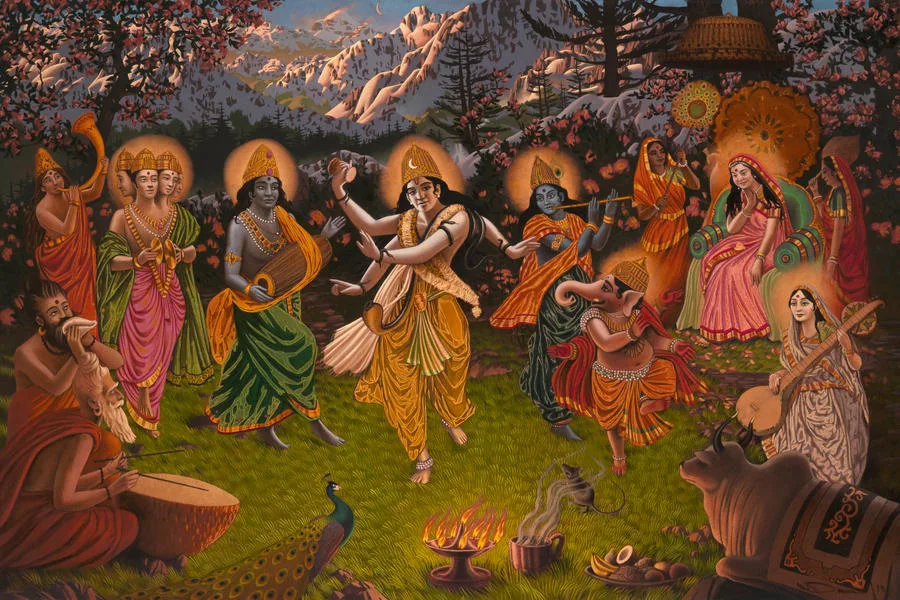
The Divine Gods , Sages , Animals and Birds
Lord Shiva :
The central dancer performing the Anand Tandav, representing the eternal cosmic cycle of creation, preservation, and dissolution.
His role in our lives is to guide us through transformation, protect devotees, and liberate souls from ignorance and ego.
Goddess Parvati :
Seated regally on the ornate throne in the upper right, presiding as the Divine Mother and supreme energy (Shakti), representing love, devotion, and spiritual strength.
Lord Brahma :
The four-faced deity on the left who represents the creative power of the universe, responsible for bringing forth new life and forms into existence.
Lord Vishnu / Krishna :
The blue-complexioned deity playing the flute on the right, serving as the preserver who maintains cosmic order, balance, and righteousness.
Lord Ganesha :
The elephant-headed deity dancing joyfully near Shiva.
He is the remover of obstacles and the lord of new beginnings, wisdom, and intellect.
Goddess Saraswati :
Seated in the lower right playing the veena, representing the embodiment of knowledge, music, arts, and wisdom that inspires creativity and learning.
Sage Narada :
The celestial sage seated with a veena near the lower right, traveling the realms to spread devotion and guide spiritual awakening through music.
The Celestial Attendants and Musicians
Horn Player (Top Left) :
A celestial musician blowing a long traditional horn to announce and elevate the divine atmosphere.
Cymbal Player (Upper Left) :
A celestial being clashing small cymbals next to Brahma to keep the precise rhythm of the cosmic dance.
Barrel Drummer (Middle Left) :
A celestial musician holding a horizontal drum (mridangam or pakhawaj) to provide the foundational percussion.
Conch Blower (Lower Left) :
A sage or devotee sounding the sacred conch shell (shankh) to mark the sacred and auspicious nature of the gathering.
Ground Drummer (Lower Left Foreground) :
A seated figure beating a large earthy drum placed directly on the grass to drive the deep beat of the celebration.
Umbrella Bearer / Royal Attendant (Upper Right near throne) :
A female celestial handmaid holding a traditional royal parasol or fan behind Goddess Parvati.
Standing Female Attendant (Far Right) :
A companion standing respectfully near the throne canopy witnessing the divine spectacle.
Attendant / Companion (Right side retinue) :
Another celestial handmaid completing the royal court attending upon the Divine Mother.
The Sacred Animal Companions
Nandi the Bull :
Resting peacefully in the lower right foreground near the sacred fire and offerings.
Nandi symbolizes eternal devotion, steadfast loyalty, and pure righteousness (dharma).
The Peacock :
Resting in the lower left foreground on the grass.
The peacock symbolizes beauty, grace, watchfulness, and the treading down of destructive habits or ego.
The Mouse (Mooshika) :
Ganesha’s tiny vehicle scurrying near the offerings on the ground.
The mouse represents subtle desires and the wandering human mind, which can be controlled and guided by wisdom.
While the fierce Rudra Tandav represents fury and destruction, the Anand Tandav represents the universe's ultimate state of ecstasy and rhythmic balance.
Importance about Anand Tandav
The State of Nataraja
Lord Shiva is visualised in this specific dancing form as Nataraja (the King of Dance).
His posture captures the eternal cycle of creation, preservation, and dissolution.
Lord Shiva is shown as a cosmic dancer who represents the endless circle of life, where everything is constantly being created, kept alive, and eventually ended to start over.
Nataraja (King of Dance): This is a famous art form and title for Shiva, showing him dancing with a specific posture and rhythm.
Creation :
Bringing new life and the universe into existence.
Preservation :
Maintaining, protecting, and taking care of the universe while it exists.
Dissolution :
The ending, melting away, or destruction of things so that change and new life can happen.
In short :
His dance isn't just for fun—it is a visual story of how the universe works, moving in a continuous loop of birth, life, and rebirth.
Cosmic Vibration (Spandana)
It means the universe starts when divine, joyful energy begins to vibrate and move, turning a state of pure, quiet peace into our active, living reality.
Cosmic Vibration (Spandana) :
A subtle, divine thrum or pulse of pure joy and energy.
Sat Chit Ananda :
Absolute existence, consciousness, and bliss—a state of total, motionless peace before anything was created.
Jagad Ananda :
The joyful, moving, physical world we experience every day.
In short :
Imagine a musician plucking a silent string; the invisible vibration creates a whole symphony.
This idea says creation works the same way—quiet stillness suddenly hums with life, turning into the universe around us.
Protection and Liberation
It means Shiva’s joyful dance is meant to keep his followers safe and free their souls from pride, selfishness, and not knowing the truth.
Anand Tandav :
The specific name for Lord Shiva's blissful, joyful cosmic dance.
Protection :
Guarding and caring for those who are devoted to him.
Liberation :
Setting the soul free (moksha) from being trapped.
Ignorance and Ego :
The mental traps of thinking we know everything, acting selfishly, or letting our pride blind us to spiritual truth.
In short :
His dance is an act of love and rescue—it breaks through our illusions and ego so our souls can finally be free and safe.
Iconography of the Dance Pose
The classic posture of the Anand Tandav, famously captured in Chidambaram Nataraja statues, carries deep symbolic meaning through its four-armed structure :
Upper Right Hand :
Holds the Damru (hourglass drum), symbolising the first sound of creation and the passage of time.
Upper Left Hand :
Holds Agni (fire), representing destruction, purification, and transformation.
Lower Right Hand :
Lifted in the Abhaya Mudra gesture, assuring protection from fear and evil.
Lower Left Hand :
Points downward toward his raised foot (Danda Hasta), symbolising the path to salvation and spiritual liberation.
The Foot Stomping the Ground :
Lord Shiva's foot rests firmly on the dwarf demon Apasmara, representing the crushing of ignorance and ego.
Cultural Representation
The Anand Tandav is heavily celebrated across classical Indian art forms.
It serves as a prominent theme in classical dance forms like Bharatanatyam, Kathak, and Odissi, where performers depict the graceful yet powerful unison of Shiva and Parvati.