The Silent Power : The Significance of Maun Vrat in Swami Samarth Seva
In the fast-paced chaos of the modern world, silence is often viewed as an absence—a void to be filled with digital noise, constant chatter, and the relentless hum of productivity.
Yet, in the tradition of Swami Samarth Seva, silence is not an absence; it is a profound presence.
It is a tool of transformation, a gateway to the Infinite, and the highest form of communication with the Sadguru.
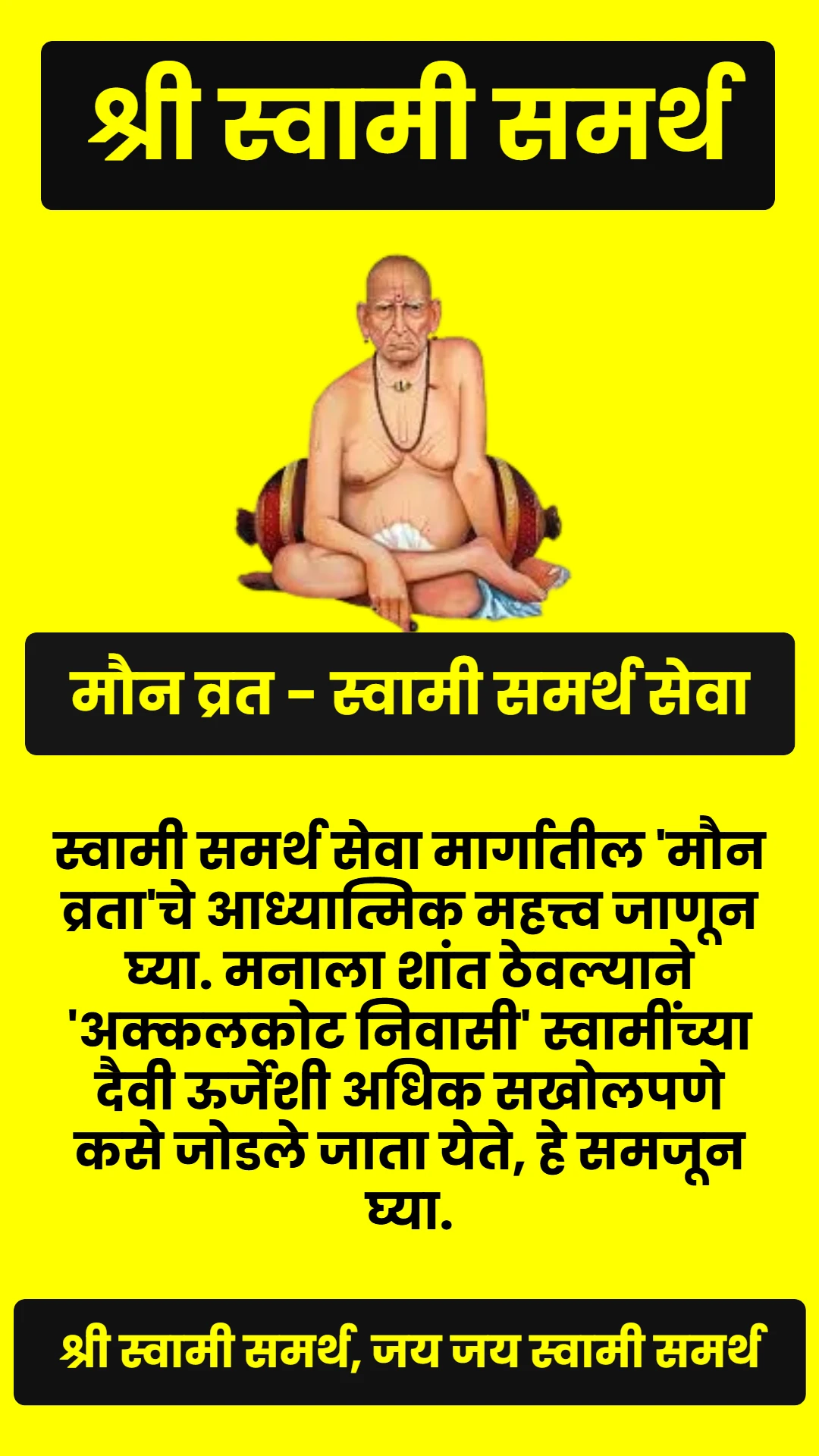
Known as Maun Vrat (the vow of silence), this practice holds a central place in the spiritual life of a Swami Samarth devotee.
But what does it truly mean to observe Maun in the context of Swami Samarth Seva ?
Is it merely the suppression of speech, or is it a deeper, internal alchemy ?
The Philosophy of Silence in the Swami Samarth Tradition
Swami Samarth of Akkalkot, often regarded as the Avatara of Lord Dattatreya, was a master of the "Silence of the Soul."
While he spoke to his devotees to guide them, his true teachings were often transmitted in the spaces between his words.
He taught that the mind is like a turbulent ocean; speech, which is an external expression of the mind, acts as the wind that keeps the waves agitated.
Maun Vrat is the practice of withdrawing this wind. By stopping the external vibration of speech, the practitioner begins to hear the "Anahata Nada" — the unstruck sound, the internal resonance of the Divine. In the context of Swami Samarth Seva, Maun is not about turning into a statue ; it is about turning inward so that the grace of Swami can manifest without the interference of the ego.
The Three Layers of Maun Vrat
In the pursuit of spiritual maturity, Swami Samarth devotees categorize silence into three progressive layers :
1. Vaachik Maun (Silence of Speech)
This is the physical act of refraining from speaking.
It is the entry point. In the Ashram or during Seva (service), devotees observe this to conserve energy.
When we speak, we expend Prana (life force).
By abstaining from unnecessary conversation, we preserve this energy, allowing it to be redirected toward meditation and the chanting of the Taraka Mantra (the protective mantra of Swami Samarth).
2. Mansik Maun (Silence of the Mind)
This is significantly more challenging.
You might stop talking, but the internal monologue—the "monkey mind"—continues to chatter, judge, plan, and regret.
Mansik Maun is the practice of silencing the thought process.
For a devotee of Swami Samarth, this involves replacing the mental noise with the remembrance of the Guru’s lotus feet. When a thought arises, the devotee gently replaces it with the name "Swami Samarth."
3. Atma Maun (Silence of the Soul)
This is the ultimate state. It is the silence that remains even when we are speaking. It is the realization that the "I" who speaks is merely an instrument, while the true Self remains untouched, unmoved, and eternally silent. This is the state Swami Samarth lived in at all times.
Why is Maun Essential for Swami Samarth Seva ?
Many devotees ask, " Why should I observe silence when I have work, family, and responsibilities ?" The answer lies in the nature of Seva.
Conservation of Spiritual Energy
When you participate in Anushthana (prescribed spiritual discipline) for Swami Samarth, your energy levels rise.
Speaking dissipates this energy.
By observing Maun Vrat, you build a "spiritual reservoir" that helps you face life's crises with the calm of the Sadguru.
Deepening the Connection with the Sadguru
Swami Samarth said, " Do not worry, I am with you."
Yet, we often fail to feel his presence because we are too loud.
We are too busy talking to others, or even talking to ourselves, to hear the subtle guidance of the Guru.
Silence clears the static.
When you observe Maun, you become a blank canvas upon which Swami can paint his instructions.
Mastery Over the Ego
The tongue is the most difficult organ to control.
It is the primary tool of the ego. By mastering the tongue, you begin to master the ego.
When you choose silence over the urge to argue, gossip, or criticize, you are effectively dismantling the ego’s ability to control your life. This is the essence of surrender (Sharanagati) to Swami.
How to Conduct a Maun Vrat: A Practical Guide for Devotees
If you are beginning your journey into silence, here is how you can integrate it into your daily Seva :
Start Small : Choose one day a week or half a day on weekends.
As you grow comfortable, you can increase the duration.
Set an Intention : Before you start your Maun, sit before a picture of Swami Samarth.
Offer your vow to him. Say, " Swami, I am observing this silence for you. May my thoughts be purified."
Use Your Time Wisely : Silence is not an excuse for passivity. During your Maun, deepen your Nama Japa (chanting), read the Shri Swami Samarth Charitra Saramrut, or simply engage in mindful service (cleaning, helping others) without the need for verbal recognition.
Practice Mindful Action : When you cannot speak, you must become more aware of your body language and your actions.
Are you grumpy because you haven't spoken? Or are you radiating peace? True Maun should make you more patient and compassionate, not irritable.
Digital Silence : In the modern age, texting and social media are forms of speech.
If you are doing Maun Vrat, try to disconnect from your phone.
True silence requires digital detachment.
The Transformation: What Happens When You Become Silent ?
Devotees who regularly observe Maun Vrat as part of their service to Swami Samarth often report profound changes :
Heightened Intuition : They find that they "know" things before they happen.
This is the guidance of the Sadguru flowing through a clear channel.
Reduced Anxiety : With the mental chatter silenced, the roots of anxiety—which are usually found in the "what-ifs" of the future or the "should-haves" of the past—start to wither.
Clarity of Purpose : Many devotees receive insights into their life's direction during their periods of silence.
The Feeling of Being "Held" : Many describe an overwhelming feeling of Swami’s protective presence.
When the external world is silenced, the internal companionship of the Guru becomes palpable.
Silence as a Mirror
Swami Samarth was known to be unpredictable—sometimes silent, sometimes stern, sometimes joyous.
He used these states to mirror his devotees. When you observe silence, you are essentially holding a mirror to your own soul.
You see the parts of yourself that are restless, insecure, and demanding.
Do not run from what you see. Instead, offer those parts to Swami.
In the space of your silence, ask Him to transform your restlessness into peace.
Integrating Silence into Daily Life
You don't always need to go to a cave or an ashram to find silence. You can practice "Active Maun" even in the middle of a busy city :
The Commute : Instead of listening to news or music, drive or travel in silence, chanting Swami Samarth to yourself.
The First Hour of the Day :
Dedicate the first hour after waking to silence.
Avoid the phone.
Sit with Swami.
This sets the tone for your entire day.
The Pause : Before responding to an email or a conversation at work, take a five-second pause.
This is a "micro-Maun."
It allows you to speak from a place of wisdom rather than reaction.
Conclusion: The Final Word is Silence
In the grand tradition of Swami Samarth Seva, we learn that all our chanting, all our rituals, and all our service are merely steps leading us toward the Ultimate Silence.
Words are the boats that carry us across the ocean of existence, but once we reach the shore, we must leave the boat behind.
Maun Vrat is the practice of stepping off the boat and standing on the shore of the Absolute.
It is the most loving gift you can offer your Sadguru.
When you become silent, you become like Swami.
You become a vessel for the Divine to pour his grace into.
So, the next time you feel the weight of the world, do not look for more words to explain it.
Do not look for more distractions to escape it.
Instead, find a quiet corner, light a lamp before the image of Swami Samarth, close your eyes, and surrender to the power of the silence.
In that silence, you will find everything you have been looking for.
You will find that you were never away from Swami, and he was never away from you.
You will find that in the stillness, the Ananta Koti Brahmanda Nayaka—the Lord of infinite universes—is waiting to speak to you, not in words, but in the language of pure, unadulterated love.
Jai Jai Swami Samarth.
Maun Wrath: The Power of Intentional Silence
"Maun Wrath" (or Mauna Vrata) is a profound spiritual practice rooted in ancient Indian philosophy.
It is not merely the absence of speech; it is a deliberate, conscious vow to observe silence for a specific period to achieve mental clarity, introspection, and spiritual elevation.
The word ‘Mauna’ originates from the Sanskrit root muni, which implies a sage or a person of deep meditation.
In our modern, hyper-connected world, our minds are constantly bombarded by external stimuli.
We expend a vast amount of energy through speech, often engaging in idle chatter, gossip, or reactive communication.
Maun Wrath acts as a reset button.
When we cease external verbal communication, the energy usually dissipated through the vocal cords and social interactions is redirected inward.
This redirection facilitates Pratyahara (withdrawal of the senses), allowing an individual to observe their thoughts without being swept away by them.
The practice can range from a few hours a day to extended periods of days or even years.
During this time, one remains mindful of every action.
It is a period of "Observing the Observer."
As the external noise dies down, the internal noise—the constant chatter of the ego—becomes louder and easier to identify.
One realizes that most of what we say is either unnecessary or driven by a desire to impress, defend, or judge.
By cutting off this output, we cultivate profound stillness.
Psychologically, Maun Wrath reduces stress and anxiety.
It teaches us the value of listening over speaking.
When we stop preparing our next sentence while someone else is talking, we listen with our entire being.
This fosters empathy and deepens relationships.
Spiritually, it is believed that silence purifies the Vak Indriya (the organ of speech), leading to Vak Siddhi, a state where one's words become truthful, impactful, and powerful.
Practicing Maun Wrath does not mean becoming socially inaccessible; rather, it is about intentionality.
Whether it is a dedicated hour of silence every morning or a full day of silence once a month, this practice allows us to detach from the ego’s need for validation.
In the stillness of Maun, we eventually find the voice of our higher self, providing us with the wisdom to navigate the chaos of life with calmness and grace.
Maun Vrat in English: Understanding the Vow of Silence
"Maun Vrat" is the Hindi term for the "Vow of Silence."
In the context of English-speaking cultures, this practice is often translated as either a spiritual retreat or a meditative discipline.
While the terminology differs, the essence remains the same : it is the voluntary abstention from speaking to deepen self-awareness, conserve energy, and attain mental tranquility.
The significance of observing a Maun Vrat in English-speaking environments has gained popularity through mindfulness movements.
Many people now view silence not just as a religious rite, but as a secular tool for productivity and mental health.
In a fast-paced corporate culture, the ability to sit in silence is seen as a hallmark of self-control and emotional intelligence.
When one commits to a Maun Vrat, they are essentially taking a break from the "Noise" of Society.
Communication is a complex social contract that requires us to maintain a certain persona.
Silence breaks this contract temporarily.
Without the need to justify, explain, or entertain, an individual experiences a unique kind of freedom.
You stop reacting to the world and start observing it.
You notice the birds, the wind, your own breathing, and the subtle shifts in your mood that were previously drowned out by the interference of daily conversation.
The benefits of practicing a vow of silence are multifaceted :
Conservation of Energy :
Speaking requires significant physiological and psychological effort.
Silence preserves this energy for deep thinking and creative problem-solving.
Enhanced Listening :
When you cannot speak, your only option is to listen and observe.
This drastically improves one's capacity to focus and process information.
Mindfulness :
Silence acts as an anchor.
It keeps you firmly in the present moment, making it nearly impossible to dwell on past regrets or future anxieties.
Clarity of Thought :
Just as a turbulent pond settles when left undisturbed, the mind settles when the constant output of speech ceases.
To start a Maun Vrat, one does not need a remote mountaintop.
It can be practiced by designating a "Silent Zone" in your home or turning off all communication devices for a set period.
The primary challenge is the initial restlessness—the urge to "fill the void." However, if one persists, the void transforms into a space of profound discovery.
In the English-speaking world, Maun Vrat is becoming a vital antidote to digital burnout, offering a gateway to peace in a loud and demanding world.
What is Mohan Vrat
Mohan Vrat (more commonly known as Maun Vrat) is a spiritual and meditative vow of silence in ancient Indian tradition.
Practiced for centuries across Hinduism, Jainism, and Buddhism, it involves abstaining from speech for a set period to calm the mind, conserve energy, and build emotional restraint.
Key Aspects of Maun Vrat
Physical Silence :
Refraining from speaking or communicating through body gestures and writing.
Mental Silence :
True Maun goes beyond just not talking; it requires stopping the internal chatter of the mind.
Top Benefits of Mohan Vrat (Maun Vrat)
Stress Reduction :
By reducing mental clutter and external stimulation, it significantly lowers anxiety.
Emotional Regulation :
Practitioners learn to pause before reacting, which helps control anger and emotional outbursts.
Better Focus :
It is highly regarded by users on spiritual platforms like Quora as a tool to enhance concentration and self-awareness.
How to Practice Maun Vrat
There are no strict rules, and it can be customized.
You can begin by simply staying silent for a few hours in a quiet environment, slowly extending it to a full day, or even practicing it during your daily meditation sessions.
What is Mouna Vratam ?
Mouna Vratam is in Sanskrit term where , Mouna (मौन) : Meaning silence, stillness, or the state of being mute and Vratam (व्रतम्) : Meaning a vow, a religious observation, or a disciplined commitment.
Mouna Vratam is a bridge between the outer world and the inner spirit.
By choosing to remain silent, you are not closing yourself off from the world; you are opening a door to your own soul.
As the ancient proverb suggests, "Silence is the language of the Divine."
By embracing it, even briefly, you allow your own inner wisdom to be heard above the noise of daily life.
Benefits of Observing Mouna Vratam
Mental Clarity and Focus: By curbing the urge to speak, the mind stops preparing for conversations and starts observing the present moment. This significantly boosts concentration.
Conservation of Energy :
Yogis often emphasize that silent observation helps in preserving mental and physical vitality, which is essential for meditation and higher spiritual pursuits.
Emotional Regulation :
Silence forces us to process our emotions internally rather than venting them out instantly.
This creates a "buffer zone" between an impulse and a reaction, fostering emotional intelligence and patience.
Listening Capacity :
When we stop speaking, we become better listeners—not just to others, but to the subtle intuitive signals of our own conscience.
FAQ : The Silent Power - The Significance of Maun Vrat in Swami Samarth Seva
Q: What is a Maun Vrat and why is it significant in the context of Swami Samarth Seva?
A : A Maun Vrat, or vow of silence, is a spiritual practice where one abstains from speaking for a certain period.
In the context of Swami Samarth Seva, Maun Vrat is a profound way to connect with the Guru's divine energies, cultivate self-awareness, and deepen one's spiritual practice.
Q: How does observing a Maun Vrat enhance one's spiritual growth during Swami Samarth Seva?
A : By committing to silence, individuals can quiet the mind, tune into their inner self, and foster a deeper sense of connection with the divine.
It allows for introspection, reflecting on the teachings, and absorbing the transformative energy of the Guru's presence.
Q: Can I still participate in ceremonies, rituals, or activities during the Maun Vrat period?
A : Yes, you can participate in the program's events, but maintain your vow of silence.
This aspect of spiritual discipline helps balance external engagement with internal focus. The seva team will ensure your needs are met while respecting your commitment.
Q: Will I be penalized or judged for not being able to complete the full Maun Vrat duration?
A : Absolutely not. The intention is to encourage and support your spiritual growth journey. If you find it challenging to maintain silence for the entire period, you can communicate with the seva team, who will guide you to gradually adapt to longer periods of silence.
Q: Can I expect any special blessings or experiences while observing the Maun Vrat during Swami Samarth Seva?
A : Many devotees have reported experiencing increased inner peace, enhanced spiritual awareness, and a deeper sense of Guru's grace during their Maun Vrat practice. However, focus on your personal growth and spiritual evolution rather than external expectations or feedback.
Q: Is the Maun Vrat applicable only during specific Swami Samarth Seva events or can I attempt it at other times as well?
A : Although it's often conducted during designated silent periods or retreats, you can certainly apply the principles of Maun Vrat to your daily spiritual practice, even if just for a few hours. Discuss your intentions with your Guru or spiritual guide for personalized guidance.
Q: How does observing a Maun Vrat align with the broader philosophy and teachings of Swami Samarth and his disciples?
A : Swami Samarth and his followers emphasize the importance of silence, self-reflection, and inner contemplation as essential steps in spiritual progression. The Maun Vrat practice aligns with these core principles, providing a powerful tool for disciples to deepen their connection with the divine and work on personal transformation.